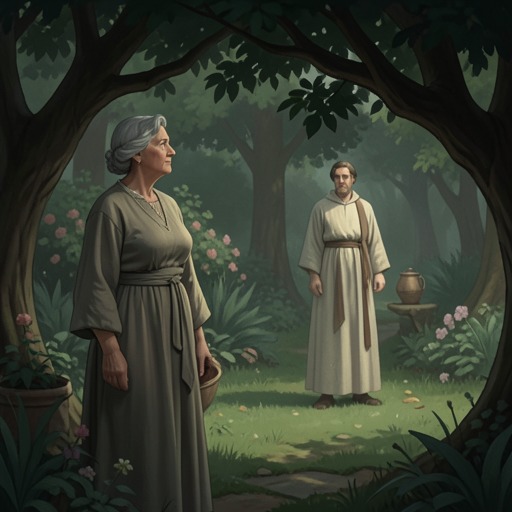
Baby Kochamma’s Unrequited Love for Father Mulligan
The God of Small ThingsBaby Kochamma’s Unrequited Love for Father Mulligan is a formative attachment that shapes both her private disappointments and her judgment of other women. At eighteen, Baby Kochamma falls in love with Father Mulligan, a young Irish monk visiting Kerala for a year. She tries to create occasions for intimacy, first through displays of charity and then through religious study; when he leaves, she enters a convent in the hope of remaining near him. The relationship never becomes a partnership, but Baby Kochamma later interprets its failure as evidence of her own restraint. That remembered, unfulfilled love becomes a measure against which she judges Ammu’s refusal to accept the limitations imposed on women.
The attachment and its setting
Father Mulligan visits Ayemenem every Thursday to see Reverend E. John Ipe, Baby Kochamma’s father. Though the two men belong to different Christian denominations, they enjoy one another’s company, and Father Mulligan is often invited to stay for lunch. Baby Kochamma, still a young woman, lingers around the table after it has been cleared. The visits provide the recurring setting for an attachment that is hers more than his: the novel describes her desire, but does not establish that Father Mulligan returns it as a love relationship.
Baby Kochamma first seeks his attention through staged acts of charity. On Thursdays, when she expects him, she washes a poor village child at the well and presents the activity as an occasion for conversation. She also raises questions about scripture. The arrangement lets her approach Father Mulligan under the cover of religious and charitable purpose, while the child’s frequent escape interrupts their conversations and brings them back to the immediate situation. In this small, repeated scene, piety is both a sincere social language and a means of arranging proximity.
The convent as an attempt to remain close
After a year of Thursday visits, Father Mulligan’s temporary stay ends and he prepares to return to Madras. Baby Kochamma turns from charity to faith, defying her father’s wishes to become a Roman Catholic. With special dispensation from the Vatican, she takes vows and enters a convent in Madras as a trainee novice. Her aim is not described as a broad religious vocation: she imagines that convent life might give her a legitimate reason to be near Father Mulligan, with theology providing the subject for their conversations.
The plan quickly proves futile. Senior sisters have access to priests and bishops and command more sophisticated biblical questions than Baby Kochamma can offer; she realizes that she may wait years for an opportunity to see Father Mulligan. She becomes restless and unhappy, and the convent deepens rather than eases her loneliness. Her letters home, sent under the name Koh-i-noor because the Mother Superior reads correspondence before it is posted, provide an indirect channel for communicating her troubles to her family.
Reverend Ipe eventually travels to Madras and withdraws his daughter from the convent. Baby Kochamma is glad to leave but refuses to return to her former denomination: she remains Roman Catholic for the rest of her life. Her father then arranges for her to study at the University of Rochester, reasoning that education is an option available to a daughter unlikely to marry. Two years later she returns with a diploma in Ornamental Gardening, still more in love with Father Mulligan than before. The education changes her qualifications and circumstances, not the attachment’s outcome.
An unresolved love and a settled self-image
In later life, Baby Kochamma explains the unconsummated love as a consequence of her own restraint and determination to do what was right. This retrospective account preserves the attachment by making its failure meaningful: she can regard herself as having chosen virtue rather than having been left without a reciprocal relationship. The novel presents this as the story she has persuaded herself to believe, not as proof that a different choice would have brought them together.
That self-understanding informs her response to Ammu. Baby Kochamma resents Ammu for quarreling with a fate that she herself believes she accepted: that of a woman without a husband, and, in her own formulation, without Father Mulligan. She treats Ammu’s divorce and intercommunity love marriage as especially outrageous. Her own renunciation of a possible marriage and Ammu’s refusal to submit to family expectations are not equivalent choices, but Baby Kochamma uses her account of restraint to judge Ammu’s resistance as intolerable.
From private disappointment to public accusation
The attachment’s later significance appears in the contrast between Baby Kochamma’s carefully maintained account of her own virtue and her effort to contain the scandal surrounding Ammu and Velutha. After Sophie Mol’s death and the children’s disappearance, Baby Kochamma goes to the Kottayam Police Station and tells Inspector Thomas Mathew that Velutha, a factory worker from a Paravan community, had tried to force himself on Ammu. She misrepresents the relationship as an assault, seeking to protect the family’s reputation in the Inspector’s eyes. As she tells the story, she begins to believe it herself.
Her presentation gives the authorities a version in which family respectability, rather than Ammu’s actual relationship, sets the terms of the account. The Inspector responds to her report and consults Comrade K. N. M. Pillai about whether Velutha has political protection. Pillai says that Velutha is on his own and does not correct the allegation, despite knowing that Velutha belongs to the Communist Party. Baby Kochamma’s actions are not evidence that her unrequited love directly causes the accusation; rather, the earlier attachment helps illuminate the judgments through which she defends her own chosen restraint and condemns Ammu’s different life.
Narrative significance
Baby Kochamma’s love for Father Mulligan is not a romance resolved by confession, separation, or reunion. Its lasting force lies in how she turns an unfulfilled desire into a moral identity. The young woman who tries to arrange Thursday meetings and enters a convent to remain near a man she loves becomes the older relative who regards Ammu’s defiance as a threat to the family’s standing. The contrast exposes the narrow terms under which women’s choices are judged in Ayemenem: Baby Kochamma’s renunciation can be recast as virtue, while Ammu’s pursuit of a life beyond those limits is treated as disgrace.
The novel places this private history beside the broader exercise of social power. In the aftermath of the tragedy, the children witness what the narrative describes as a demonstration of human beings pursuing ascendancy through structure, order, and monopoly. Baby Kochamma’s report participates in that world not because the text makes her old attachment a simple cause of events, but because her need to defend family reputation helps turn a concealed relationship into an official accusation. Her unrequited love thus matters twice: first as the loss around which she builds a story about herself, and later as part of the perspective through which she polices another woman’s freedom.